Welcome to My New 20th Century Russian History Blog!
Image: The Ural Mountain Range via Dorling Kindersley Limited
Welcome to my blog!
I have created this blog for my Twentieth Century Russian history class. Follow along as I take a more in-depth look at some of the lesser known aspects of Russia and the Soviet Union
The Works of Sergei Mikhailovich Prokudin-Gorskii (1863-1944)
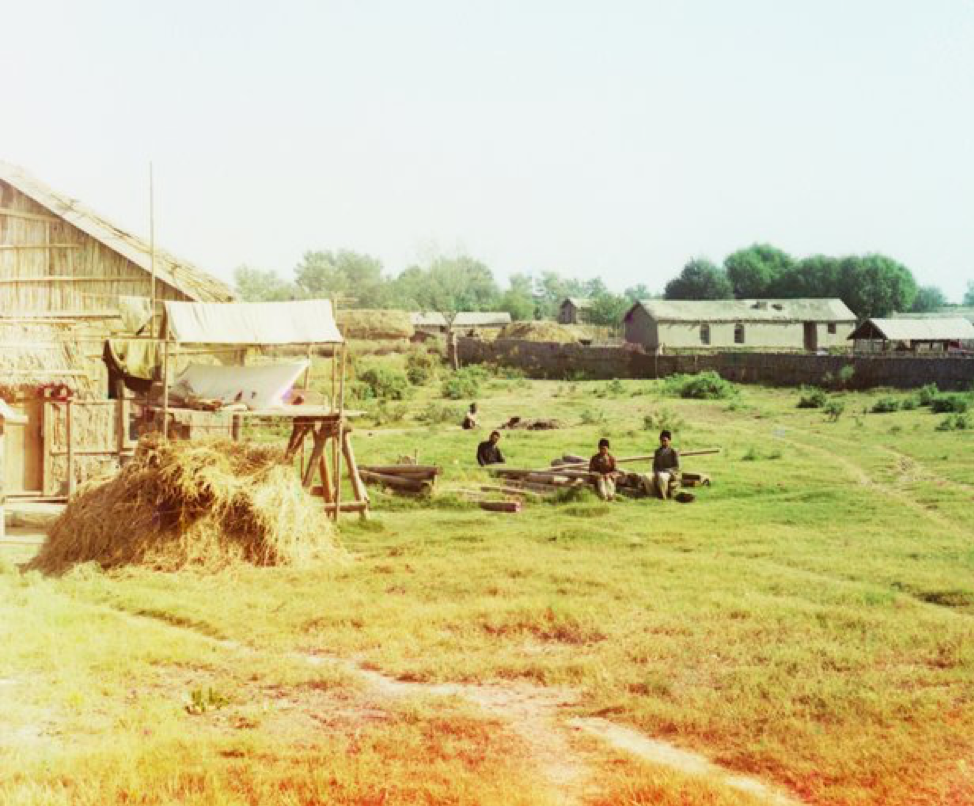
The image you see above is titled “Village of Saatli. Mugan Steppe” taken in 1905 by Sergei Mikhailovich Prokudin-Gorskii. During his travels throughout the Russian Empire, Gorskii traveled to the Caucasus region in 1904-1905 to photograph the many settlements established by various Russian subjects. The village of Saatli, pictured above, was established by Ukrainian migrants. Saatli is a shining example of Russian expansionist policy as well as its ethnic and geographic diversity. The settlers are seated on logs and wearing the distinctive sheepskin hats of Eastern Europe, surrounded by buildings made of wattle and mud. The areas surrounding the Aras River proved to be extremely harsh, with hot summer temperatures and the constant danger of flooding from the nearby Aras River. What I find most interesting about Gorskii’s photographs of the Caucasus is that they were made possible by the railroad system that further connected the Russian Empire under Sergei Witte’s industrialization policies of the late 19th century. As a result, the Russian Imperial frontier was increasingly connected with Russia itself.
https://en.wikipedia.org/wiki/Saatly_District
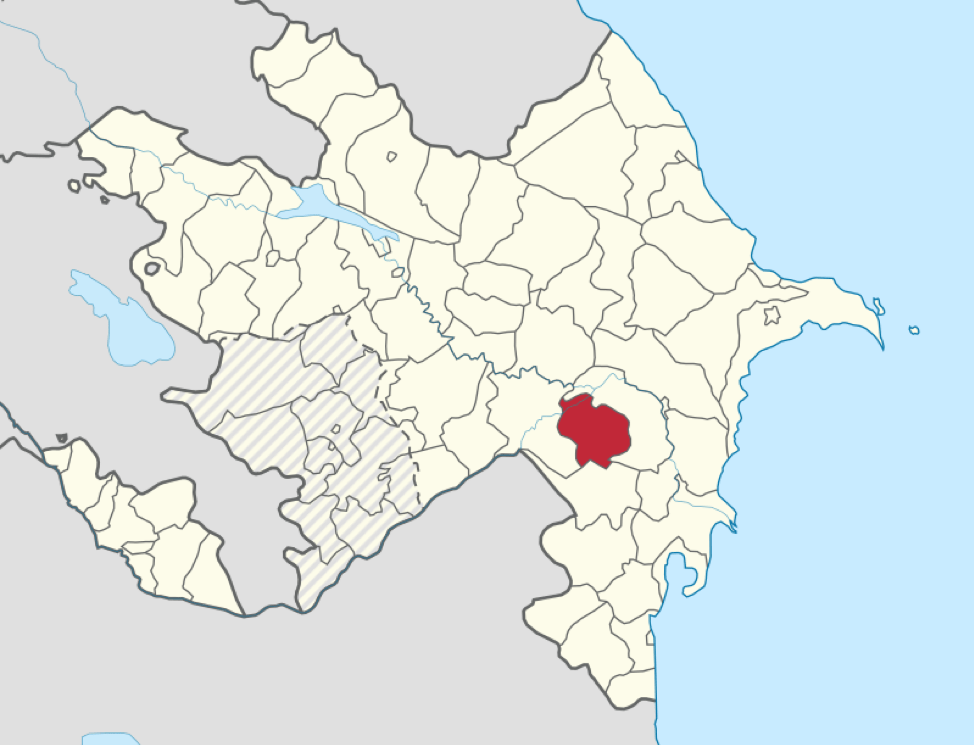
As seen on the map above, Saatli is situated on the right bank of the Aras River (visible in the northern part of the red outline) very close to the border with Persia (contemporary Iran) and approximately 3,074 kilometers south of St. Petersburg, Russia. Gorskii’s photographs in the Caucasus illustrate the far-reaching power of the Russian Empire and how the resettlement policies of the latter 19th Century shaped the region (Shafiyev, pg. 5).
However, when the above photograph was taken in 1905, “the rebellious sentiments, combined with weakness of state control, was turning the borderlands into the staging-ground and bastion of revolution” (Freeze, pg. 233). While the peasants of the Caucasian frontier endured the hardships of daily life, the Russian military had suffered a humiliating defeat at the hands of the Japanese in 1904-1905, demonstrating the weakness of the Russian state, and raising “the level of political unrest in almost every layer of society and within every political grouping, pushing Russian political dialogue several degrees to the left” (Freeze, 249). The Ukrainians seen in Gorskii’s photograph were among one of several national minorities that had “significant nationalist, socialist, and liberal (sometimes all three simultaneously) movements” in Transcaucasia on the eve of the Revolution (Freeze, pg. 256). However, the Ukrainian and Polish minorities throughout the Russian Empire faced “uneasy hostility” from political groups such as the Kadets and Octobrists who increasingly opposed minority aspirations during this time (Freeze, pg. 257).
Russian imperial claims in the Caucasus date back to the construction of the Tarki fortress on the Caspian Sea under Tsar Ivan IV in 1559 (Nation, pg. 1). In the subsequent years, Russian claims expanded to the banks of the Aras River, which became the border between the Russian Empire and Persia following the 1829 Treaty of Turkmenchay which concluded a series of wars between Russia and the Ottoman and Persian Empires (Nation, pg. 1). Based on the precedent set by Peter the Great’s resettlement of Russians in St. Petersburg in 1703 after the fall of the Swedish fortress of Nyenschantz, the Russian government encouraged and/or forced Russian subjects to resettle in frontier zones to create “loyal space in the borderland,” and the area of Saatli was no exception (Shafiyev, pg. 5).
The objective behind the resettlement program in the Caucasus was to establish a Christian majority and force out the Muslim populations that resisted Russian occupation and made the area “a cauldron of unrest and armed resistance (Freeze, pg. 224). Though the bulk of the peasants encouraged to settle in the Caucasus by force or otherwise were Germans, Armenians, and Russians, Ukrainians were also settled there as they “were Orthodox by faith” and had “been Russified to a considerable degree” (Freeze, pg. 222).
“Village of Saatli. Mugan Steppe” is one of many examples of the extent of Russian imperial power Russian policies. It is very interesting to see how the Russian government sent people from one occasionally unstable region of the empire (Ukraine) to another (the Caucasus) to quell dissent and resistance as part of Russification. Furthermore, it makes me wonder what the people in the photograph were thinking and doing as the Revolution was beginning 3,000 kilometers to the north while they were struggling to provide for themselves and their families on a daily basis. Personally, this photograph puts the Russian Empire on the eve of Revolution into perspective as its effects were felt in the far corners of the Empire.
Works Cited
Freeze, Gregory L. Russia: A History. New York: Oxford University Press, 2009.
Nation, R. Craig. “Russia and the Caucasus.” Academic Paper. 2015.
https://www.jstor.org/stable/pdf/26326394.pdf?refreqid=excelsior%3A42e7349dd1fd8b275be9381fd6eb144e
Shafiyev, Farid. The Russian-Soviet Resettlement Policies and their Implications for Ethno-Territorial Conflicts in the South Caucasus. PhD Thesis. Ottawa: Carleton University , 2015.
Click to access shafiyev-therussiansovietresettlementpoliciesandtheir.pdf
Follow My Blog
Feel free to follow my blog to receive updates and notifications about future posts!
The Soviet Invasion of Afghanistan: Because if Alexander the Great, Genghis Khan, the Persians, and the British couldn’t do it, we obviously can
On 27 December 1979, members of a Soviet airborne brigade were airlifted into Kabul, Afghanistan to overthrow the Afghan government and install a sympathetic regime, thus making the same mistake as several great empires had made before them. Within hours of the initial troop deployment, Soviet forces had overwhelmed the Afghan presidential guard and captured…

The Enemy of My Enemy: Partisans on the Soviet Frontier (1941-1945)
The Second World War saw partisan movements in nearly every conflict zone and occupied territory in the world, and the Eastern Front was no exception. Concentrated in occupied Latvia, Lithuania, Estonia, Poland, Belarus, and Ukraine, underground resistance movements were organized to disrupt and defeat the German eastern advance. In some cases, these same partisan groups…
Fighting Capitalism with Capitalism: NEP and Russian Youth
The image above is a poster titled “6,000,000 Children Not Served By Schools” (1923). The poster warns that homeless children will resort to crime and begging if they are not helped. The New Economic Policy (NEP) was introduced in the Tenth Party Congress in March 1921 as a means to reinvigorate the Russian economy following…
 Eric's 20th Century Russia Blog
What a terrific post! You’ve done a wonderful job of using the image to explore the broader tensions of Empire and modernization in this period. And your outside sources are good as well. The Caucasus are so crucial (geopolitically and culturally), and so often overlooked — thanks for writing about Ukrainian settlement in this region.
LikeLike